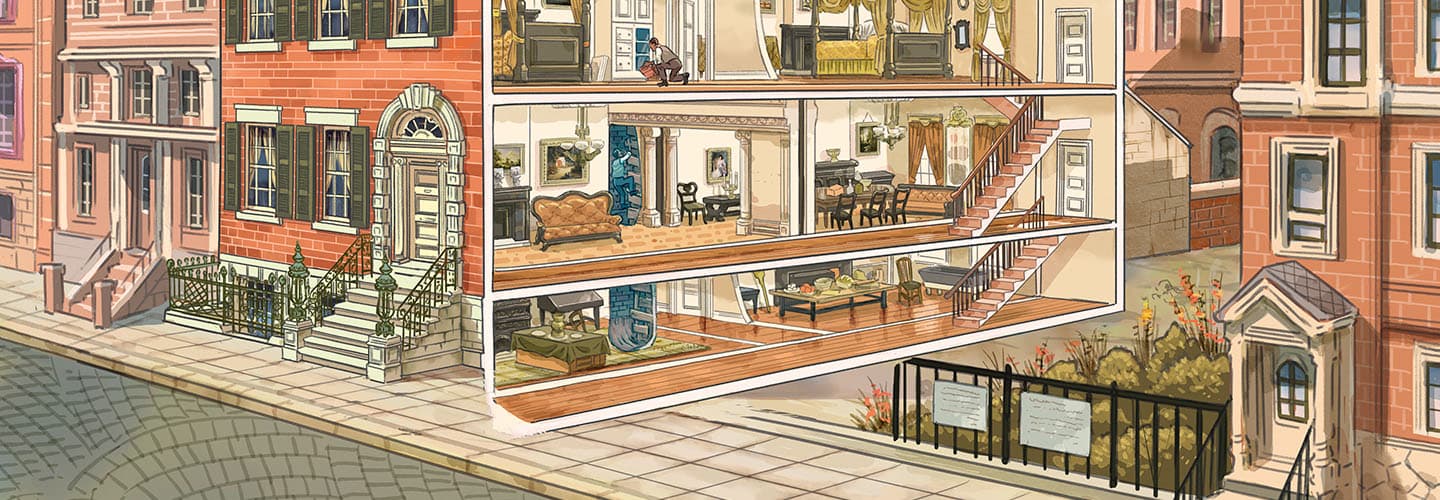
A brick townhouse with its interior floors and furnished rooms visible through a cutaway view

Building illustration by Kyungeun Park

Standards

Secret Hideout

A hidden passageway in New York City may have helped people escape slavery. 

Upstairs in an old building in New York City, visitors will find an ordinary-looking dresser in the bedroom. But the dresser holds a secret. Pull out the bottom drawer and a hidden trapdoor is revealed. It leads to a dark, narrow passageway with a ladder going down to the ground floor. 

The secret space is located in what is now the Merchant’s House Museum. In February, researchers announced it was likely used to help people escape slavery on the Underground Railroad. It’s the first intact Underground Railroad stop discovered in New York City in more than 100 years.

The Underground Railroad
Watch a video to learn more about the Underground Railroad.

Freedom Network

The Underground Railroad wasn’t a train. It was a secret network of houses, routes, and humans that helped enslaved Black people escape to freedom. Enslaved people had no rights and were forced to work without pay. 

The network included safe houses called “stations” and “conductors,” or people who guided others from one stop to the next. From 1790 to 1860, about 100,000 enslaved people used the Underground Railroad to find freedom.

The journey was dangerous. Anyone who was caught could be forced back into slavery. Those who helped freedom seekers also faced punishment. 

People looking to capture those using the Underground Railroad searched high and low. So, conductors sometimes used secret signals, like a lamp in a window or a curtain tied a certain way, to show which homes were safe. The people helping had to be creative. 

“There were secret attics, stairwells, and passageways,” says historian Kellie Carter Jackson. “You couldn’t just hide in a closet, because that’s the first place someone’s going to look.”

Hidden Away

Why do experts believe the passageway at the Merchant’s House Museum was part of the Underground Railroad? For one, the building was once a home, built by Joseph Brewster in 1832. He was an abolitionist, or someone who worked to end slavery. 

Plus, researchers say the hidden passage had no other purpose, such as storage. And no other homes built at the time were known to have similar passages. 

Jackson says the space under the dresser was a clever hiding spot. After all, no one would have thought a person could fit in a dresser drawer. The space would have been hot and cramped as people crouched there for hours.

“But it was protected, and that’s what’s most important,” Jackson says.

Connected to History

Researchers may never know exactly who used the hidden passage or when. Since helping people on the Underground Railroad was illegal, abolitionists rarely kept written records. Still, Jackson says the hiding spot provides an important link to history. 

“This is a space that connects us to a real moment in history,” she says. “It gives us a different perspective, and it makes history real.”

1. Based on the article, what was the Underground Railroad?

2. What are two clues that lead experts to believe that the hidden passageway was part of the Underground Railroad?

3. How do the drawings and photos on pages 4 and 5 add to your understanding of the article?

videos (2)
videos (2)
Skills Sheets (3)
Skills Sheets (3)
Skills Sheets (3)
Games (1)
TEACHER SUPPORT (1)
Text-to-Speech