

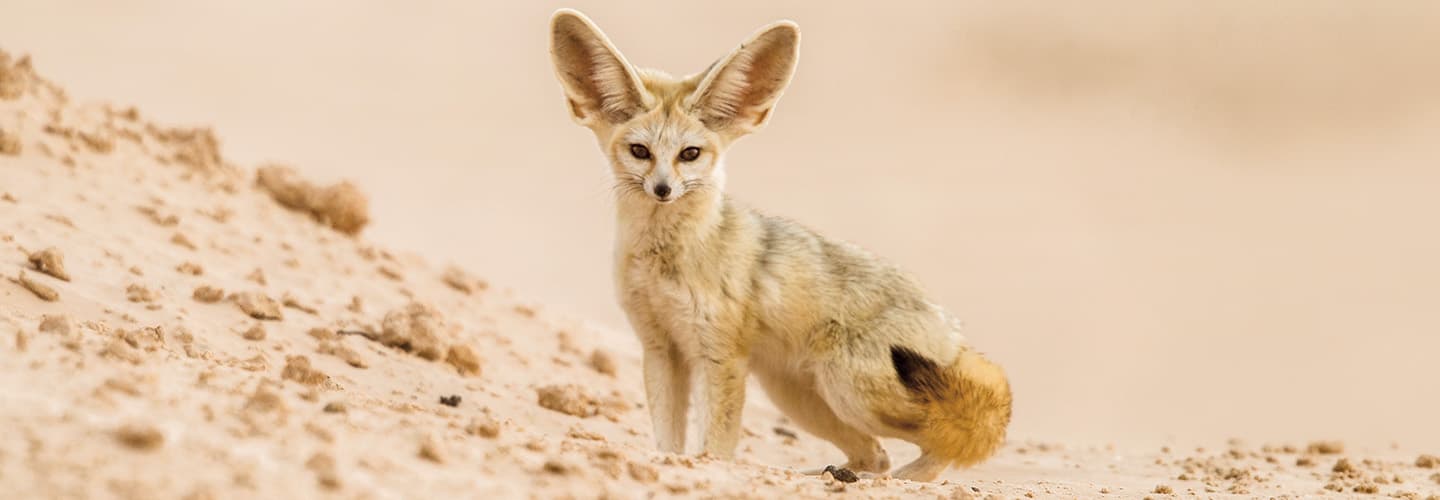

A fennec fox with large ears stands on a sandy desert surface and faces forward

Bruno D’Amicis/NaturePL.com 

Standards

Built to Survive

These creatures have what it takes to live in the harshest environments.

Shutterstock.com

An illustration of a tardigrade

What’s tiny, has eight legs, and can survive in conditions that would kill many other animals? A tardigrade! Also known as water bears, these critters are only about the size of the period at the end of this sentence. Yet they’re some of the toughest creatures on Earth. They can live deep in the ocean, high up on mountains—and can even survive in space.

How? Over millions of years, tardigrades have adapted to different environments. In dry places, tardigrades enter a state of rest called cryptobiosis. Their dormant bodies slow down and use almost no energy until water is available again. This adaptation also helps them survive other conditions, like extreme cold or heat.

“Nature’s really good at finding natural solutions to really difficult problems,” says scientist Melody Clark.

Here’s a look at three more animals that can survive in extreme environments.

Fennec Fox

Bruno D’Amicis/NaturePL.com

Fennec fox

These small foxes live in the hot, sandy deserts of northern Africa and Arabia. Temperatures there can climb above 120 degrees Fahrenheit. Fennec foxes have several adaptations that help them survive.

Staying cool starts with the fox’s giant ears. They act like natural radiators, releasing extra body heat. The fox’s light-colored fur reflects sunlight and protects its skin from the sun. And thick fur on the fox’s feet acts like built-in boots, shielding the animals from the scorching sand.

Fennec foxes are also nocturnal. That means they sleep during the day and are active at night, when the desert is cooler. Like tardigrades, they can go a long time without drinking water. They get the water they need from the plants they eat. That helps them stay healthy even during long periods without rainfall.

Himalayan Jumping Spider

Gavin Maxwell/NaturePL.com

Himalayan jumping spider

These tiny spiders live on Mount Everest, the highest mountain in the world. They’ve been found among frozen rocks nearly 22,000 feet above sea level. That’s about 4 miles up! At that height, the air is thin, temperatures are freezing, and no plants can grow. Himalayan jumping spiders are some of the highest-living animals in the world.

Unlike many spiders, these creepy crawlers don’t spin webs to catch food. Instead, they eat insects that are blown up the mountain by the wind.

Anglerfish

Norbert Wu/Minden Pictures

Anglerfish

Anglerfish live in the darkest parts of the ocean. Some are found up to 13,000 feet below the surface, where sunlight cannot reach. To attract prey in the darkness, they use a glowing lure that hangs in front of their mouths like a fishing pole. The lure glows thanks to bioluminescent bacteria—living things that produce their own light.

Still, finding food in the deep sea isn’t easy. So anglerfish are built to make the most of every chance to eat. Their huge mouths and long, sharp teeth help them grab and swallow prey. They often stay still and wait for animals to swim nearby. Then the anglerfish strike!

1. Describe one way tardigrades and fennec foxes are alike and one way they are different.

2. What kinds of conditions make Mount Everest a challenging environment for living things?

3. What does the author mean when she writes that “anglerfish are built to make the most of every chance to eat”?

Skills Sheets (3)
Skills Sheets (3)
Skills Sheets (3)
Games (1)
TEACHER SUPPORT (1)
Text-to-Speech