

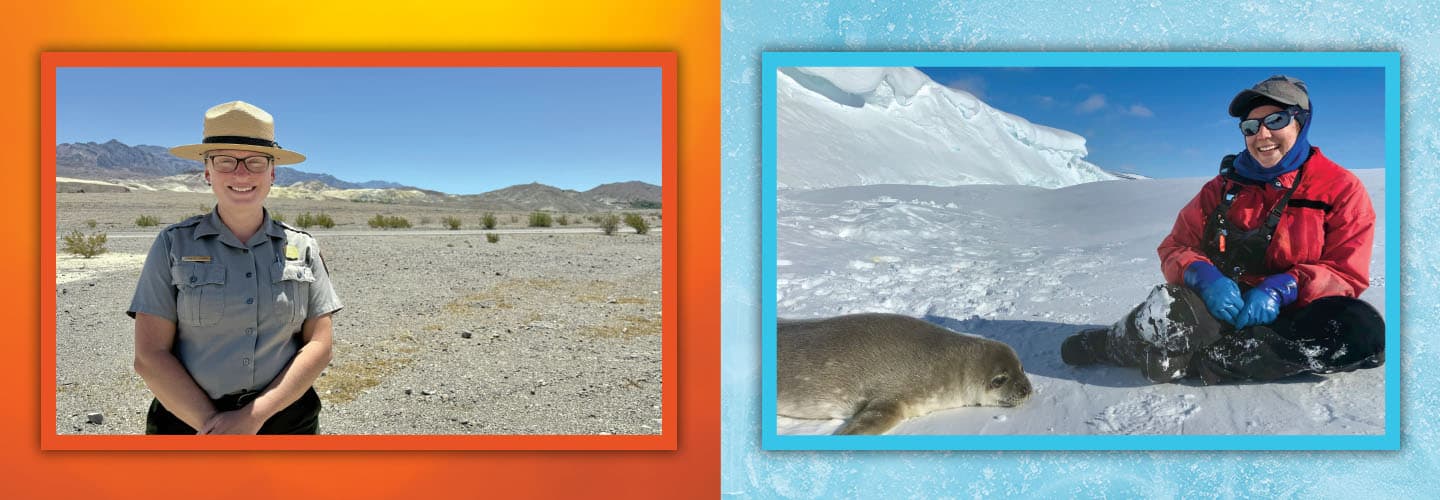

Two portraits of a woman, one as a park ranger in a desert and one beside a seal on ice

Left: Jennette Jurado; Right: Parker Levinson

Courtesy Jennette Jurado (Jurado); Courtesy Parker Levinson/ Taken under NMFS Permit No. 26375 (Levinson)

Standards

Would You Rather Work in Extreme Heat or Extreme Cold?

Courtesy Jennette Jurado

Jennette Jurado

Jennette Jurado’s coworkers sometimes wear oven mitts when they drive to work. They’re not chefs. Like Jurado, they’re park rangers at Death Valley National Park—the hottest place on Earth. And their steering wheels are often too hot to touch.

“You can put a tray of cookies on your dashboard, and in a couple hours they’ll be baked,” Jurado says. 

Death Valley stretches across parts of California and Nevada. Air temperatures there can soar above 120 degrees Fahrenheit in the summer. 

“You’re breathing in this hot air that’s like it’s straight out of the oven,” Jurado explains. 

Jennette Jurado’s coworkers sometimes wear oven mitts to drive to work. They’re not chefs. Like Jurado, they’re park rangers at Death Valley National Park. That’s the hottest place on Earth. Steering wheels are often too hot to touch.

“You can put a tray of cookies on your dashboard, and in a couple hours they’ll be baked,” Jurado says. 

Death Valley stretches across parts of California and Nevada. Air temperatures there can soar above 120 degrees Fahrenheit in the summer. 

“You’re breathing in this hot air that’s like it’s straight out of the oven,” Jurado explains.

Shutterstock.com 

Death Valley

Heating Up

Jim McMahon/Mapman®

Death Valley’s extreme temperatures have a lot to do with the landscape. Much of the valley lies below sea level, surrounded by mountains. Air slides down the mountainsides, pressing into the valley and heating up as it moves. There’s little rain to cool things down.

Jurado says she and her coworkers are resilient enough to stand the heat and take care of the extreme place they work in. Still, when it’s too hot, park rangers work outside only in an emergency, such as when someone needs to be rescued. Visitors are advised to stay within a 10-minute drive of air-conditioning and to drink plenty of water.

In 1913, the temperature in the park hit a world record 134 degrees. Every summer, people travel to Death Valley hoping to experience heat that will break that record. Jurado feels the excitement, but she also worries about the risks.

“I can’t help wonder how hot is too hot for people and wildlife to survive,” she says.

Death Valley’s extreme heat is related to the landscape. Much of the valley lies below sea level, surrounded by mountains. Air slides down the sides of the mountain. It presses into the valley and heats up as it moves. There’s little rain to cool things down.

Jurado says she and her coworkers are resilient. They can stand the heat and take care of their extreme job site. But when it’s too hot, park rangers work outside only in an emergency. That could be when someone needs to be rescued. Visitors are told to drink plenty of water. They should stay within a 10-minute drive of air-conditioning. 

In 1913, the temperature in Death Valley hit a world record. It was 134 degrees. Every summer, people travel there hoping to experience heat that will break that record. Jurado feels the excitement. But she also worries about the risks.

“I can’t help wonder how hot is too hot for people and wildlife to survive,” she says.

The World's Most Extreme Places
Watch a video about the most extreme places on the planet.

Courtesy Parker Levinson/ Taken under NMFS Permit No. 26375

Parker Levinson

The wind was picking up, and researcher Parker Levinson was getting colder. She had just driven her snowmobile across miles of thick sea ice to check on a group of seals. But before she got to work, she climbed off the snowmobile and jogged around it. She had to do something to warm up!

For Levinson, it’s all part of the job. She studies seals in Antarctica, the coldest continent on Earth.

“Your skin feels cold, your bones feel cold,” she says. “You feel like you’re never going to be warm again.”

The wind was picking up. Researcher Parker Levinson was getting colder. She had just driven her snowmobile across miles of thick sea ice. She was about to check on a group of seals. But before she got to work, she climbed off the snowmobile and started jogging. She had to do something to warm up!

For Levinson, it’s all part of the job. She studies seals in Antarctica. It’s the coldest continent on Earth.

“Your skin feels cold, your bones feel cold,” she says. “You feel like you’re never going to be warm again.”

Shutterstock.com 

Antarctica

An Icy Workplace 

Jim McMahon/Mapman®

Antarctica is about 1.5 times the size of the United States, yet no one lives there year-round. Levinson is there from October through December, which is summer in Antarctica. About 5,000 other people also work in Antarctica during its summer.

Levinson works at McMurdo Station, the largest research base in Antarctica. It’s like a tiny town in the middle of the ice, with a cafeteria, a fire station, a store, and more.

“It’s all the things you need to live in this inhospitable area,” Levinson says. “There’s a real sense of community.”

For most of the summer, the sun never sets, providing 24 hours of daylight. And temperatures rarely go above freezing. They sometimes dip to –10 degrees Fahrenheit. 

Still, Levinson rides out onto the frozen ocean each day to tag seal pups so scientists can track them as they grow. 

“Working in Antarctica is a unique experience,” she says.

Antarctica is about 1.5 times the size of the United States. But no one lives there year-round. Levinson is there from October through December. That’s summer in Antarctica. About 5,000 other people also work in Antarctica during its summer.

Levinson works at McMurdo Station. It’s the largest research base in Antarctica. It’s like a tiny town in the middle of the ice. There’s a cafeteria, a fire station, a store, and more.

“It’s all the things you need to live in this inhospitable area,” Levinson says. “There’s a real sense of community.”

For most of the summer, the sun never sets. So there are 24 hours of daylight. And temperatures rarely go above freezing. They can dip to –10 degrees Fahrenheit. 

Still, Levinson rides out onto the frozen ocean each day to tag seal pups. That allows scientists to track them as they grow. 

“Working in Antarctica is a unique experience,” she says.

1. Why does the article mention cookies when describing Death Valley National Park?

2. What is the meaning of inhospitable? Why does the article describe Antarctica as inhospitable?

3. Based on the article, how do Jennette Jurado’s and Parker Levinson’s job responsibilities compare?

1. Why does the article mention cookies when describing Death Valley National Park?

2. What is the meaning of inhospitable? Why does the article describe Antarctica as inhospitable?

3. Based on the article, how do Jennette Jurado’s and Parker Levinson’s job responsibilities compare?

videos (2)
videos (2)
Skills Sheets (3)
Skills Sheets (3)
Skills Sheets (3)
Games (1)
TEACHER SUPPORT (1)
Leveled Articles (1)
Text-to-Speech