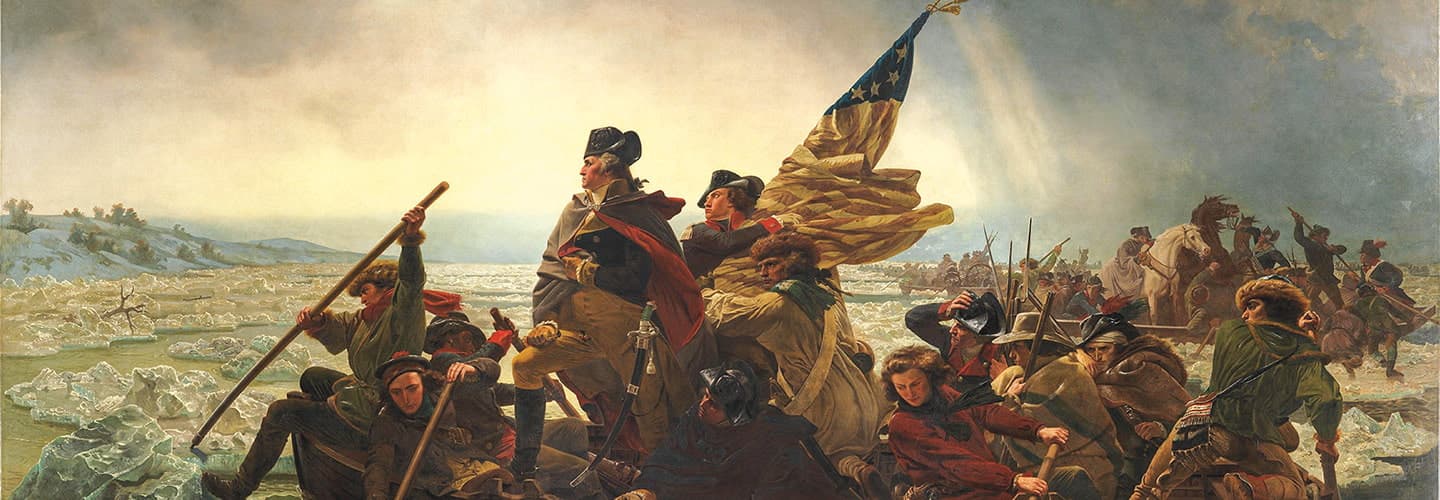
George Washington stands in a boat as soldiers row through broken ice & another holds the flag aloft

Album/Alamy Stock Photo

Standards

Surprise Attack!

George Washington kept America’s fight for freedom alive 250 years ago.

Bitter wind blew blinding snow through the air. It was late at night on December 25, 1776. Though it was Christmas, General George Washington and his army weren’t feeling very merry. They nervously stood on the banks of the half-frozen Delaware River.

The army was fighting the American Revolution, which had begun in 1775. The 13 Colonies wanted freedom from Great Britain. Washington planned to attack the enemy by surprise that night. If his plan failed, the Revolution might be lost.

On the Run

Jim McMahon/Mapman®

Washington was the leader of the colonial army. It was mostly made up of farmers and shopkeepers. These inexperienced soldiers were fighting against the British military, one of the strongest in the world.

In August 1776, the British won the Battle of Long Island, in New York. More than 2,000 colonial soldiers were killed, hurt, or captured. More losses soon followed. Washington’s army was forced to retreat from New York (see map). 

By that time, morale among the soldiers was low. They were tired, cold, and lacked supplies. Many colonists were losing faith in the Revolution. 

What You Need to Know About the American Revolution
Watch a video to learn more about how the United States came to be.

A Daring Plan 

Washington knew he had to do something quickly. Many of his soldiers had signed on to fight only until the end of the year. He needed a victory to inspire them to stay.

So he planned a daring attack on Trenton, New Jersey. The town was defended by about 1,400 Hessians. These soldiers from Germany had been hired by the British to help fight the colonists.

Washington planned to sneak across the Delaware River into New Jersey. On the night of December 25, Washington and his men climbed into their boats. They took 50 horses and 18 cannons. The troops slowly made their way across the icy river. A storm soaked their thin coats with sleet and snow. 

By early morning, about 2,400 soldiers had arrived in New Jersey. But they still had to march four hours to Trenton. 

“Their feet were bleeding because they were stepping on jagged ice,” says historian Stewart Davenport. 

When Washington’s forces arrived in Trenton, they took the Hessians by surprise. Colonial troops killed the Hessian commander and took nearly 900 prisoners. The battle was over in less than two hours.

The Road Ahead

The stunning victory at the Battle of Trenton lifted spirits around the colonies. 

“Washington proved that the American cause was not dead and that the Americans were going to continue to fight,” says Davenport. 

The Revolution lasted nearly another seven years. But Washington’s plan had paid off. Many of his men stayed on to fight. And he showed the colonists that becoming a free nation was still possible. 

1. What is morale? Based on the article, why was the morale of the colonial army low in much of December of 1776?

2. Why did Washington’s army cross the Delaware River into New Jersey?

3. What does the author mean when she writes that “Washington’s plan had paid off”?

videos (2)
videos (2)
Skills Sheets (3)
Skills Sheets (3)
Skills Sheets (3)
Games (1)
TEACHER SUPPORT (1)
Text-to-Speech