
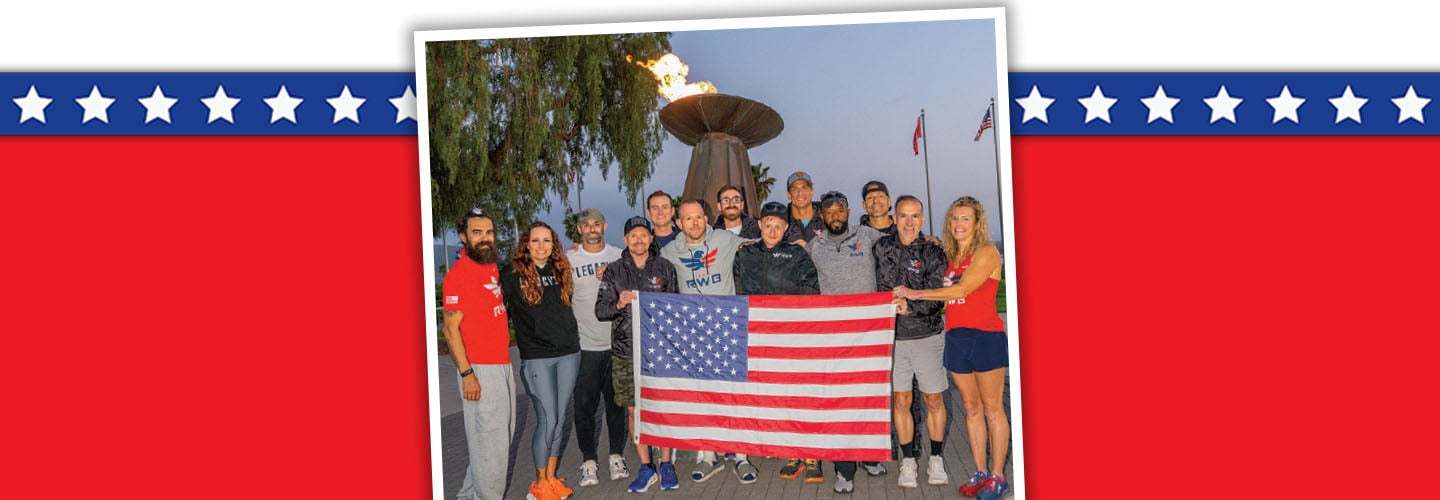

Team Red, White, and Blue poses before the race.

Teamrwb.org (holding flag); Shutterstock.com (star border); 

Standards

Stars and Stripes

A group of veterans carried one of the nation’s most important symbols across the country. 

Teamrwb.org

Michael “Sully” Sullivan

In May, 12 military veterans ran more than 3,000 miles across the United States. They took turns carrying an American flag. Their journey began in San Diego, California. It ended just over two weeks later in Washington, D.C.

The run was called the Old Glory Ultra Relay. Team Red, White, and Blue (RWB) faced blazing heat, pouring rain, and even snow. Whether jogging in cities or on country roads, they never let the flag stop moving.

Team RWB completed the longest continuous relay of an American flag. But this wasn’t just about setting a record. The event raised about $1 million for programs that help veterans. And it was a chance for people to celebrate what the flag stands for. 

“It represents what’s good about our nation—where we’ve been and where we can go,” explains Michael “Sully” Sullivan. He’s a retired U.S. Army Special Forces officer and the executive director of Team RWB. 

American Symbols
Watch a video to learn about some symbols of the United States.

A Powerful Symbol

The American flag has a long history. After the U.S. declared independence in 1776, the new nation needed a symbol. In 1777, the Second Continental Congress chose the first official American flag.

The original design included 13 stars and 13 stripes, one for each of the colonies. As the country grew, a star was added for each new state. So far, there have been 27 official versions of the American flag. 

Over the years, the flag has come to stand for pride and hope. It flies in front of schools and government buildings, has been raised by U.S. soldiers in battles, and was even planted on the moon.

Teamrwb.org 

Johnny Glenn runs the Old Glory Ultra Relay on May 7. 

Running Strong

Team RWB has been hosting events to honor the flag for 15 years. For the Old Glory Ultra Relay, runners needed to keep the flag moving nonstop. They split into teams of four. Each team took an eight-hour shift. During that time, each teammate would run for about two hours. Then they would pass the flag to the next runner. Meanwhile, the other two teams would drive ahead to the next leg of the relay. 

Veteran Johnny Glenn served for 21 years in the U.S. Army Special Forces. On Team RWB, he ran more than 240 miles. Glenn was tired and his legs ached. But the people who cheered him on along the way helped him persevere.

“Seeing Americans come out and support us because they know the sacrifice we made kept my mind and heart going,” Glenn says. 

A Special Flag

The flag used in the relay is special to Sullivan. He kept it with him while serving during the war in Afghanistan in 2009. He was proud to donate it to the relay ahead of America’s 250th birthday.

“We’re lucky to have this internationally recognized symbol,” says Sullivan. “It represents us all, no matter where we come from.”

1. How did the Old Glory Ultra Relay help veterans?

2. The article shares details about how runner Johnny Glenn was able to persevere in the relay. How do these details help you understand the meaning of the word persevere?

3. According to the sidebar, “Famous Flags,” what story about the American flag is most likely just a legend? How does the sidebar support that idea?

videos (2)
videos (2)
Skills Sheets (1)
Games (1)
TEACHER SUPPORT (1)
Text-to-Speech