
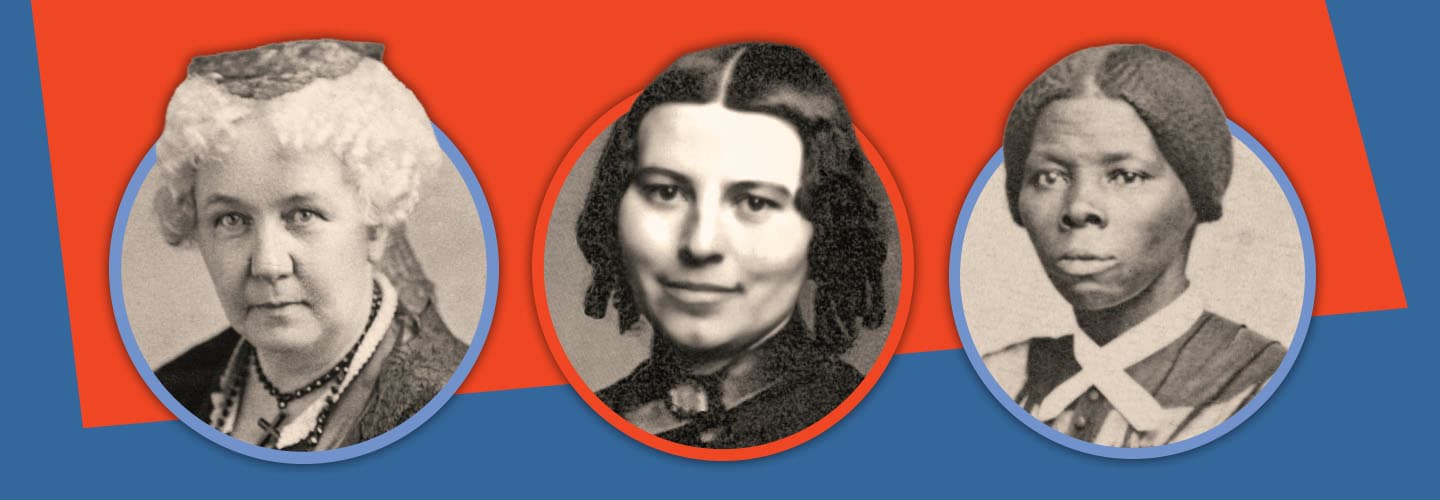

ZUMA Press, Inc./Alamy Stock Photo (Elizabeth Cady Stanton); Science History Images/Alamy Stock Photo (Clara Barton); Heritage Art/Heritage Images via Getty Images (Harriet Tubman)

Standards

Women Who Shaped America 

Women have played important roles in the United States over the past 250 years. Many of them are celebrated at some of the hundreds of national parks and historic places across the nation. Here’s a look at some of the women who are honored at these sites.

ZUMA Press, Inc./Alamy Stock Photo

Elizabeth Cady Stanton

1815-1902 

Epics/Getty Images

One of the most visited buildings at the Women’s Rights National Historical Park is Wesleyan Chapel (right). In July 1848, about 300 people gathered at the site in Seneca Falls, New York. The Seneca Falls Convention was the first big public meeting about women’s rights in U.S. history. Elizabeth Cady Stanton helped organize it. She read a document she had written called the Declaration of Sentiments. It was modeled after the Declaration of Independence. It included the first official call for women’s suffrage. In 1920, the 19th Amendment to the U.S. Constitution finally gave women across the U.S. the right to vote.

The Struggle for Women's Rights
Watch a video about the long fight for women’s rights.

Science History Images/Alamy Stock Photo

Clara Barton

1821-1912 

Jeffrey Isaac Greenberg 16+/Alamy Stock Photo

Clara Barton was working in Washington, D.C., when the Civil War (1861-1865) broke out. Though she had no training as a nurse, she delivered medical supplies and cared for wounded soldiers. Barton came to be known as the “Angel of the Battlefield.” 

Later Barton founded the American Red Cross. She served as its president for 23 years. Barton’s home in Maryland was the organization’s first permanent headquarters. It’s now the Clara Barton National Historic Site. And the Red Cross still provides aid to victims of disasters. 

Heritage Art/Heritage Images via Getty Images

Harriet Tubman

1822-1913 

Each year, thousands of people visit the Harriet Tubman Underground Railroad National Historical Park in Church Creek, Maryland. Many walk through the woods where the abolitionist escaped slavery.

Tubman was born into slavery in Maryland. At the time, slavery was legal there. Enslaved people had no rights and were forced to work without pay. In 1849, Tubman escaped to freedom using the Underground Railroad. That was a secret network of people, routes, and hiding places. Tubman later risked her life to lead hundreds of others to freedom. 

Pictorial Press Ltd/Alamy Stock Photo

Rosie the Riveter

In the early 1940s, many men left their jobs to fight in World War II (1939-1945). To encourage women to fill these roles, the U.S. government turned to a fictional character named Rosie the Riveter. (A riveter is someone who attaches sheets of metal using special pins called rivets.) Over time, these women became known as “Rosies.”

Today they’re honored at the Rosie the Riveter WWII Home Front National Historical Park in Richmond, California. And the image of Rosie showing off her muscles remains a symbol of the strength of women everywhere.

1. What happened at Wesleyan Chapel in 1848, and how did the event shape history?

2. Why was Clara Barton known as the “Angel of the Battlefield”?

3. What did the U.S. government hope to accomplish by creating the fictional character Rosie the Riveter?

videos (2)
videos (2)
Skills Sheets (2)
Skills Sheets (2)
Games (1)
TEACHER SUPPORT (1)
Text-to-Speech