

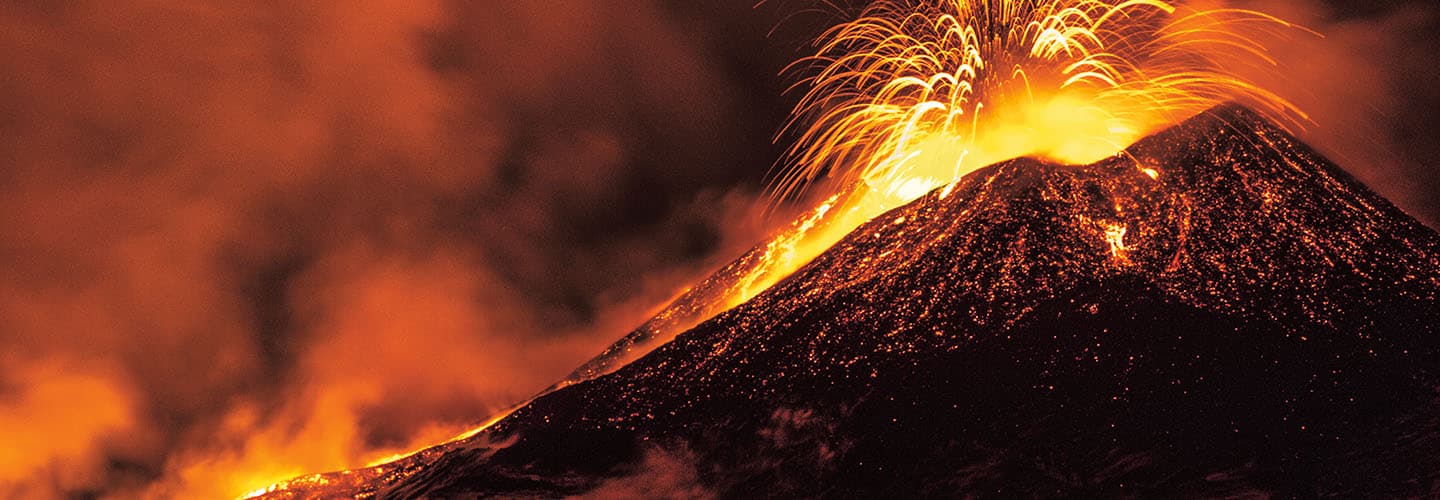

Volcano erupting with bright orange lava and sparks shooting from the crater

Mount Etna erupts on Sicily, an island that’s part of Italy.

Antonio Zanghì/Getty Images

Standards

Playing With Fire

Millions of people visit active volcanoes, some getting near enough to feel the lava’s heat. But how close is too close?

As You Read, Think About: How can tourists stay safe when visiting volcanoes?

What You Need to Know About Volcanoes
Watch a video to learn more about the fiery wonder of volcanoes.

In June 2025, a peaceful day on the Italian island of Sicily turned scary. As tourists snapped selfies at Mount Etna, the volcano suddenly roared to life. Ash and dark clouds of smoke shot into the air. People ran for their lives.

The volcano erupted again this past December. After that, officials put new restrictions in place to keep visitors safe.

Each year, about 1.5 million people visit Mount Etna, the most active volcano in Europe. It isn’t the only volcano drawing crowds. Worldwide, millions of people travel to active volcanoes. 

“They’re very exciting to visit,” says Jessica Ball. She’s a volcanologist at the U.S. Geological Survey. “And we want people to be able to enjoy them while also staying safe.”

It was June 2025. A peaceful day turned scary on Sicily. That’s an Italian island. As tourists snapped selfies at Mount Etna, the volcano suddenly roared to life. Ash and smoke shot into the air. People ran for their lives. 

The volcano erupted again in December. So officials put new restrictions in place to keep visitors safe.

Each year, about 1.5 million people visit Mount Etna. It’s the most active volcano in Europe. But it isn’t the only volcano drawing crowds. Around the world, millions of people travel to active volcanoes. 

“They’re very exciting to visit,” says Jessica Ball. She’s a volcanologist at the U.S. Geological Survey. “And we want people to be able to enjoy them while also staying safe.”

Chasing Lava

Not all volcanoes are alike. Mount Etna is a stratovolcano. It has steep sides and can erupt in explosive ways. Shield volcanoes, on the other hand, have gentler slopes. Kilauea, on the Big Island of Hawaii, is a shield volcano. Lava usually oozes out more slowly—but not always. Volcanoes erupt when magma, melted rock inside Earth, rises toward the surface. 

Keaton Terry is a student at Utah Valley University. He’s visited about 30 volcanoes.

“The first time you see an eruption, it’s unforgettable,” Terry explains. “It’s one of the most impressive natural displays on Earth.” 

Not all volcanoes are alike. Mount Etna is a stratovolcano. It has steep sides. And it can erupt violently. Shield volcanoes, on the other hand, have gentler slopes. Kilauea, on the Big Island of Hawaii, is a shield volcano. Lava usually oozes out of them more slowly—but not always. Volcanoes erupt when magma rises to the surface. Magma is melted rock inside Earth.

Keaton Terry is a student at Utah Valley University. He’s visited about 30 volcanoes.

“The first time you see an eruption, it’s unforgettable,” Terry says. “It’s one of the most impressive natural displays on Earth.”

Robin Weaver/Alamy Stock Photo

People watch as the Meradalir volcano erupts in 2022 in Iceland.

Tourism Turns Risky

As exciting as volcanoes are, they can also be dangerous. Fortunately, scientists can often predict when major eruptions will happen. 

“Most volcanoes give us signs they’re going to erupt,” Ball explains. “They have earthquakes, change shape, or release more gases.”

Still, some eruptions happen suddenly, giving people little time to get to safety. 

“Every couple of years or so, Etna has big explosions,” says Ball. “Even geologists can be caught off guard.”

At temperatures of nearly 2,300 degrees Fahrenheit, lava is hot enough to burn your skin or start fires. Volcanoes also release poisonous gases. Some eruptions blast rocks and ash high into the air. 

To prevent accidents, officials at volcanoes like Etna and Kilauea set up viewing areas a safe distance away from the action. Officials also recommend that tourists wear masks and know escape routes.

“You want to be aware of what’s happening around you, not just focused on your camera,” Ball advises.

Volcanoes are exciting. But they can also be dangerous. Luckily, scientists can often tell when major eruptions will happen. 

“Most volcanoes give us signs they’re going to erupt,” Ball explains. “They have earthquakes, change shape, or release more gases.”

Still, some eruptions happen suddenly. That means visitors have little time to get to safety. 

“Every couple of years or so, Etna has big explosions,” says Ball. “Even geologists can be caught off guard.”

Lava is nearly 2,300 degrees Fahrenheit. It’s hot enough to burn your skin or start fires. Volcanoes also give off poisonous gases. Some eruptions blast rocks and ash into the air. 

To prevent accidents, officials at volcanoes like Etna and Kilauea set up viewing areas away from the action. They also suggest that tourists wear masks and know escape routes.

“You want to be aware of what’s happening around you, not just focused on your camera,” Ball says.

Safety First

After Etna’s recent increase in activity, Italian officials set new rules to keep people safe. One rule says tourists must stay at least 660 feet (about the length of two football fields) away from flowing lava.

Many tour guides say the rules are too strict and are hurting their business. For example, tours are now banned after dusk. But guides argue that this is the best time to view glowing lava. 

Terry isn’t going to stop visiting volcanoes. But he’ll always follow the rules. 

“Volcano tourism can be safe and educational,” he says. “But only if people respect nature’s power.”

After Etna’s recent eruptions, Italian officials set new rules to keep people safe. One rule says tourists must stay at least 660 feet away from flowing lava. That’s about the length of two football fields.

Many tour guides say the rules are too strict. They say the rules are hurting their business. For example, tours are now banned after sunset. But guides argue that this is the best time to see glowing lava.   

Terry won’t stop visiting volcanoes. But he’ll always follow the rules. 

“Volcano tourism can be safe and educational,” he says. “But only if people respect nature’s power.”

Inside an Eruption

Mount Etna is a stratovolcano. Here’s how one erupts.

Mount Etna is a stratovolcano. Here’s how one erupts.

Shutterstock.com

1. Hot liquid rock called magma collects in the magma chamber. Over time, pressure builds. 

2. Magma rises through a tube called the central vent or through smaller side vents. Gases inside the magma expand as it rises.

3. When the pressure gets too strong, the volcano erupts. Lava, ash, and rocks can explode out in fiery bursts. (Lava is magma that has reached Earth’s surface.)

4. Lava and ash cool and harden. Over time, these layers stack up to form the volcano’s steep, rocky sides.

1. Hot liquid rock called magma collects in the magma chamber. Over time, pressure builds. 

2. Magma rises through a tube called the central vent or through smaller side vents. Gases inside the magma expand as it rises.

3. When the pressure gets too strong, the volcano erupts. Lava, ash, and rocks can explode out in fiery bursts. (Lava is magma that has reached Earth’s surface.)

4. Lava and ash cool and harden. Over time, these layers stack up to form the volcano’s steep, rocky sides.

1. Why do you think the author chose the title “Playing With Fire” for the article?

2. What are some steps officials have taken to try to keep volcano tourists safe?

3. Based on the diagram, “Inside an Eruption,” what is the difference between magma and lava?

1. Why do you think the author chose the title “Playing With Fire” for the article?

2. What are some steps officials have taken to try to keep volcano tourists safe?

3. Based on the diagram, “Inside an Eruption,” what is the difference between magma and lava?

videos (2)
videos (2)
Skills Sheets (3)
Skills Sheets (3)
Skills Sheets (3)
Games (1)
TEACHER SUPPORT (1)
Leveled Articles (1)
Text-to-Speech