

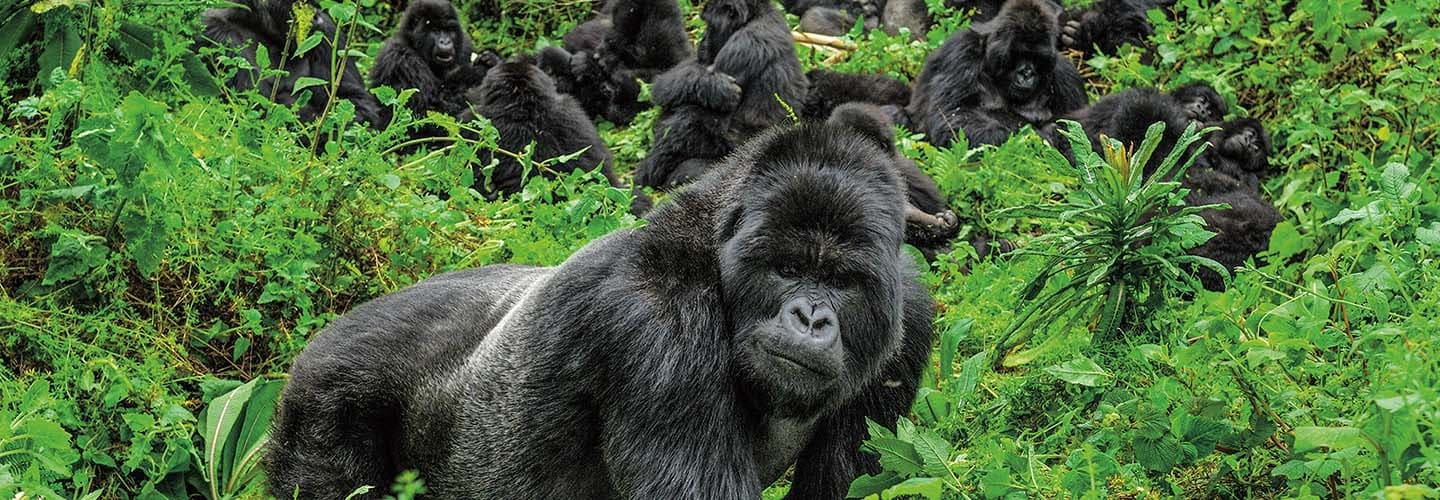

Mountain gorillas live in groups of up to 25 that are led by an adult male, called a silverback.

Thomas Marent/Minden Pictures

Standards

Meet a Gorilla Doctor

Nelson Bukamba is part of a team of veterinarians working to protect endangered mountain gorillas.

As You Read, Think About: What are some challenges the Gorilla Doctors face?

Primate Time
Watch a video to learn more about these mammals.

Deep in the rainforest of Uganda, a male mountain gorilla was in trouble. The gorilla had gotten his wrist caught in a type of trap called a wire snare. Now the great ape was high up in a tree. It was clear he was in pain. If the snare wasn’t removed, it could cause an infection. The gorilla might lose his hand. 

That was the scene in June 2025. A team of veterinarians had been watching the injured ape for hours. When he finally came down, the team sprang into action. A vet cut the wire, then cleaned the wound and treated it with medication. The gorilla was soon back to his usual self.

These vets are part of a group called the Gorilla Doctors. They work in three countries in East Africa, where fewer than 1,100 mountain gorillas are left in the wild. The death of even one of these endangered gorillas is a huge loss.

“Our slogan is ‘Saving a species, one gorilla at a time,’” explains Nelson Bukamba. He’s one of the veterinarians who assisted during the snare rescue. “Every individual in this population matters.” 

Deep in the rainforest of Uganda, a male mountain gorilla was in trouble. He had gotten his wrist stuck in a wire snare. That’s a type of trap. Now the great ape was high up in a tree. He was in pain. The snare needed to be removed. If it wasn’t, it could cause an infection. The gorilla might lose his hand. 

That was the scene in June 2025. A team of veterinarians had been watching the ape for hours. When he came down, the team sprang into action. A vet cut the wire and treated the wound. The gorilla was soon back to his usual self.

These vets are called the Gorilla Doctors. They work in three countries in East Africa. There, fewer than 1,100 mountain gorillas live in the wild. The death of even one gorilla is a big loss.

“Our slogan is ‘Saving a species, one gorilla at a time,’” says Nelson Bukamba. He’s one of the vets who helped during the snare rescue. “Every individual in this population matters.”

Apes in Danger

Bukamba works in Bwindi Impenetrable National Park in Uganda. It is one of the last refuges for mountain gorillas. Many of the other forests where the gorillas once lived have been turned into farmland. In addition, wars in the region have led to many gorilla deaths. 

Today diseases are one of the biggest threats to the endangered apes. Gorillas are closely related to humans. So they can easily catch diseases from people. Illnesses range from the common cold to life-threatening viruses.

Bukamba works in Bwindi Impenetrable National Park. That’s in Uganda. It is one of the last refuges for mountain gorillas. Gorillas once lived in other forests. But many of those have been turned into farmland. Wars in the area have also led to many gorilla deaths. 

Today diseases are one of the biggest threats to the apes. Gorillas are closely related to humans. So they can easily catch diseases from people. Illnesses range from the common cold to life-threatening viruses. 

Gorilla Guardians

Bukamba and three other vets spend several days a week checking on gorillas in Bwindi. They keep a safe distance to avoid stressing out the animals. They watch closely for any signs of injury or illness. 

The doctors intervene only when an ape is at serious risk. Even then, the vets use extreme caution because gorillas can be difficult patients. 

To protect the mountain gorillas and themselves, the vets often use tranquilizer darts to knock out the apes before treating them. But the patients never leave the wild. The vets like to say the forest is their hospital.

Bukamba and three other vets check on gorillas in Bwindi several days a week. They keep a safe distance from the animals. That’s to avoid stressing them out. They watch closely for signs of injury or illness. 

The vets intervene only when an ape is at serious risk. Even then, the vets use extreme caution. Gorillas can be difficult patients. 

The vets often use tranquilizer darts to knock out the apes before treating them. That protects both the gorillas and the vets. But the patients never leave the wild. The vets like to say the forest is their hospital. 

Courtesy ©Gorilla Doctors

A vet removes a wire snare from a gorilla’s hand.

Hope for the Future

The Gorilla Doctors are making an impact. Mountain gorillas are the only great ape species whose numbers have grown in recent years. 

Last year, the Gorilla Doctors took part in a gorilla census, or official count. It was the first in Bwindi since 2018. They hope the results will show that gorilla numbers are still growing. In the meantime, Bukamba is proud to care for the apes.

“I find myself very lucky to be contributing to the work of restoring the population,” says Bukamba.

The Gorilla Doctors are making an impact. Mountain gorillas are the only great ape species that has grown in number recently. 

Last year, the Gorilla Doctors took part in a gorilla census. That’s an official count. It was the first in Bwindi since 2018. The vets hope the results will show that gorilla numbers are still growing. In the meantime, Bukamba is proud to care for the apes.

“I find myself very lucky to be contributing to the work of restoring the population,” says Bukamba.

Where Do Mountain Gorillas Live?

Jim McMahon/Mapman®

1. What does the author mean when he writes that “the death of even one of these endangered gorillas is a huge loss”?

2. Based on the article, describe three threats that mountain gorillas have faced.

3. How does the author support the claim that the work of the Gorilla Doctors is having a big impact?

1. What does the author mean when he writes that “the death of even one of these endangered gorillas is a huge loss”?

2. Based on the article, describe three threats that mountain gorillas have faced.

3. How does the author support the claim that the work of the Gorilla Doctors is having a big impact?

videos (2)
videos (2)
Skills Sheets (3)
Skills Sheets (3)
Skills Sheets (3)
Games (1)
TEACHER SUPPORT (1)
Leveled Articles (1)
Text-to-Speech