
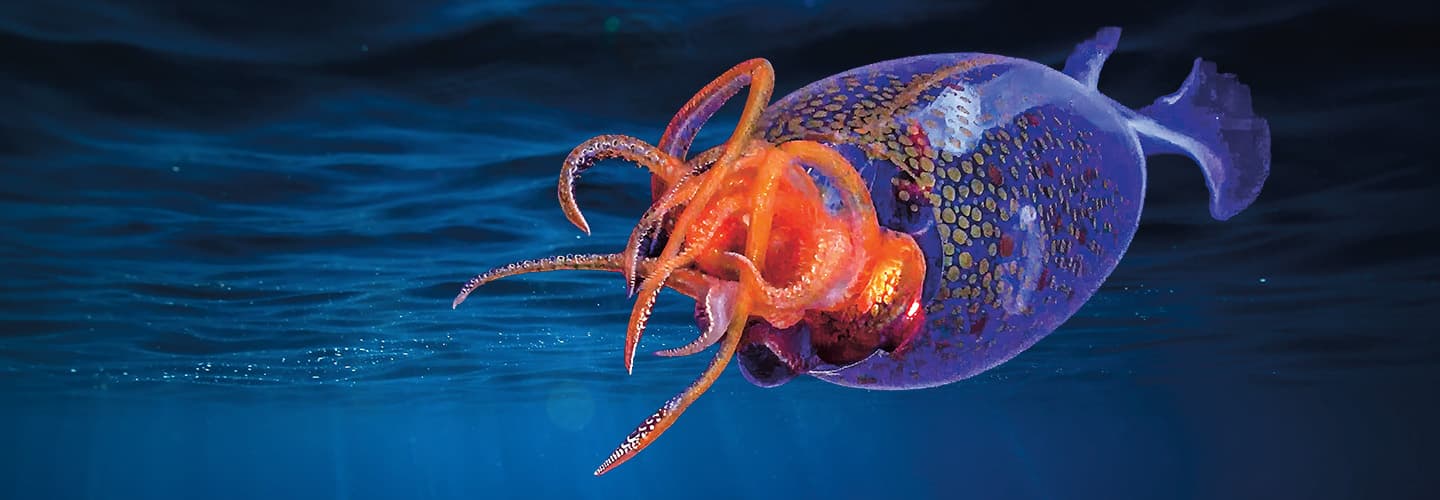

Colossal squid

ROV SuBastian/Schmidt Ocean Institute

Standards

Secrets of the Sea

The largest global effort to discover and protect ocean life is underway. What will scientists find? 

As You Read, Think About: Why is so much of the ocean unexplored?

What You Need to Know About Oceans
Take a deeper dive into the amazing ocean.

A shark-like fish that looks like a guitar. A snail with spear-like teeth. A colorful coral garden. 

These are just a few of the amazing discoveries recently made during the Ocean Census. The 10-year project, which began in 2023, is the biggest effort yet to document and protect ocean life. About 1,500 scientists from more than 85 countries are taking part. They’re racing to find species hidden in the deepest parts of the sea—before it’s too late.

A fish that looks like a guitar. A snail with sharp teeth. A colorful coral garden. 

These amazing discoveries were recently made during the Ocean Census. The 10-year project began in 2023. It’s the biggest effort yet to find and protect ocean life. About 1,500 scientists are taking part. They’re from more than 85 countries. They’re racing to find species in the deep sea—before it’s too late.

The Nippon Foundation-Nekton Ocean Census_Schmidt Ocean Institute © 2025

A coral reef

Into the Unknown

Scientists estimate that more than 2 million species may live in the world’s oceans. Yet only about 250,000 have been discovered so far.

“We’re only really scratching the surface of how much we know about the extraordinary diversity of ocean life,” says Maya de Paz. She’s a member of the Ocean Census team. 

In fact, about 95 percent of the ocean remains unexplored by humans. Why? For one, the ocean is incredibly deep. In some places, it extends more than 6 miles below the surface. That’s deep enough to fit almost 25 Empire State Buildings stacked on top of each other! 

The deepest parts of the ocean are dark and extremely cold. And the weight of the water above is crushing. Most divers can descend only a few hundred feet. Beyond that, they must travel in underwater vehicles called submersibles or send robots to explore.

Scientists say that more than 2 million species may live in oceans around the world. Yet only about 250,000 have been found so far.

“We’re only really scratching the surface of how much we know about the extraordinary diversity of ocean life,” says Maya de Paz. She’s a member of the Ocean Census team. 

In fact, about 95 percent of the ocean has not been explored by people. Why? For one, the ocean is very deep. In some places, it extends more than 6 miles below the surface. That’s deep enough for 24 Empire State Buildings to fit stacked on top of each other! 

The deepest parts of the ocean are dark. They’re extremely cold. And the weight of the water above is crushing. Most divers can descend only a few hundred feet. Beyond that, people must travel in underwater vehicles called submersibles. Or they send robots to explore.

The Nippon Foundation-Nekton Ocean Census_Schmidt Ocean Institute © 2025

The “death-ball” sea sponge

Fascinating Finds

The Ocean Census team has already taken part in more than a dozen research trips around the globe. They send remote-operated vehicles (ROVs) thousands of feet beneath the surface. The ROVs take photos and videos and scoop up samples for scientists to study.

So far, the team has found more than 900 new species! Many were found in the deepest parts of the ocean.

“The deep sea often provides the weirdest, most wonderful creatures,” says de Paz.

One of her favorites is the “death-ball” sea sponge. It looks like it’s covered in Ping-Pong balls and has sharp hooks to catch prey. Scientists spotted it in March 2025 nearly 12,000 feet deep in the Southern Ocean, near Antarctica.

On that trip, an ROV also took the first video ever of a colossal squid. It was a baby, about 1 foot long. Some adults grow to be 23 feet long and weigh 1,100 pounds. They’re the heaviest invertebrates (animals without backbones).

The Ocean Census team has taken more than a dozen research trips around the globe. They send remote-operated vehicles (ROVs) deep underwater. The ROVs take photos and videos. They collect samples for scientists to study.

So far, the team has found more than 900 new species! Many were found in the deepest parts of the ocean.

“The deep sea often provides the weirdest, most wonderful creatures,” says de Paz.

One of her favorites is the “death-ball” sea sponge. It looks like it’s covered in Ping-Pong balls. It has sharp hooks to catch prey. Scientists spotted it in March 2025. It was nearly 12,000 feet deep in the Southern Ocean. That’s near Antarctica.

On that trip, an ROV also took the first video ever of a colossal squid. It was a baby. It was about 1 foot long. Some adults grow to be 23 feet long. They can weigh up to 1,100 pounds. They’re the heaviest invertebrates (animals without backbones).

More to Discover

Experts say documenting ocean life can help protect it. The sea faces several threats, like warming waters and pollution. By studying sea species, scientists can learn how to keep them—and their homes—healthy.

“There is so much we can learn from these incredible creatures,” says de Paz.

With more trips in the works, the Ocean Census team can’t wait to see what else is waiting to be found!

Experts say recording ocean life can help protect it. The sea faces several threats. These include warming waters and pollution. By studying sea species, scientists can learn how to keep them and their homes healthy.

“There is so much we can learn from these incredible creatures,” says de Paz.

The Ocean Census team has more trips planned. They can’t wait to see what else is waiting to be found!

Layers of the Ocean

Scientists divide the ocean into five zones, or layers. Most known species live in the top two zones. Here’s a look at some of the creatures discovered by the Ocean Census team.

Scientists divide the ocean into five zones, or layers. Most known species live in the top two zones. Here’s a look at some of the creatures discovered by the Ocean Census team.

Illustration by Kate Francis; The Nippon Foundation-Nekton Ocean Census_Richard Smith © 2025 (pygmy pipehorse, deep-sea snail); The Nippon Foundation-Nekton Ocean Census_Sergey Bogorodsky © 2025 (guitar shark); Martin Hartley_The Nippon Foundation-Nekton Ocean Census © 2024 (limpet, sea star); COURTESY OCEANLAB, UNIVERSITY OF ABERDEEN (snailfish)

0 FEET: SUNLIGHT ZONE

About 165 feet: Pygmy pipehorse

About 600 feet: Guitar shark

660 FEET: TWILIGHT ZONE

About 1,300 feet: Deep-sea snail

3,300 FEET: MIDNIGHT ZONE

Many animals in these zones glow. That helps them find food in the dark.

About 9,800 feet: White sea star

About 10,000 feet: Limpet

13,100 FEET: ABYSSAL ZONE

19,700 FEET: HADAL ZONE

This white snailfish was spotted in 2017. Will the Ocean Census team find other creatures down this deep?


Zones and animals are not shown to scale. Most figures are rounded.

0 FEET: SUNLIGHT ZONE

About 165 feet: Pygmy pipehorse

About 600 feet: Guitar shark

660 FEET: TWILIGHT ZONE

About 1,300 feet: Deep-sea snail

3,300 FEET: MIDNIGHT ZONE

Many animals in these zones glow. That helps them find food in the dark.

About 9,800 feet: White sea star

About 10,000 feet: Limpet

13,100 FEET: ABYSSAL ZONE

19,700 FEET: HADAL ZONE

This white snailfish was spotted in 2017. Will the Ocean Census team find other creatures down this deep?


Zones and animals are not shown to scale. Most figures are rounded.

1. Based on the article, what is the purpose of the Ocean Census?

2. Why is so much of the ocean still unexplored, according to the article?

3. What is the meaning of the word diversity? How does the article support the idea that the ocean has a diversity of life?

1. Based on the article, what is the purpose of the Ocean Census?

2. Why is so much of the ocean still unexplored, according to the article?

3. What is the meaning of the word diversity? How does the article support the idea that the ocean has a diversity of life?

videos (2)
videos (2)
Skills Sheets (3)
Skills Sheets (3)
Skills Sheets (3)
Games (1)
TEACHER SUPPORT (1)
Leveled Articles (1)
Text-to-Speech